> For the complete documentation index, see [llms.txt](https://docs.nexomc.com/llms.txt). Markdown versions of documentation pages are available by appending `.md` to page URLs; this page is available as [Markdown](https://docs.nexomc.com/mechanics/custom-trident.md).
# Custom Trident
Nexo allows you to make custom tridents and trident-projectiles.\
This feature will work best on 1.21.4+ servers but will also work on lower ones\
The Trident-mechanic is pretty straight-forward, but also has some optional properties, mainly applicable to lower versions.
By default any item using TRIDENT as it's material is a Custom Trident\
The Trident-Mechanic is not strictly necessary unless one wants to tweak the properties
### Properties
`thrown_item_model` - The ItemModel to show on the Trident-projectile.\ Unspecified defaults to`Components.item_model`if specified.\
`thrown_item` - Refers to the NexoItem to display for the Projectile.\ Defaults to the item of this mechanic if unspecified\
`display_transform` - Lets you set the Transform the model should use\
`rotation` - Lets you rotate the base yaw/pitch of the projectile\
`damage` - The base-damage the Trident will do when hitting an entity, defaults to 8\
`sounds` - The sounds the Trident should make, defaults to replicating vanilla.
#### Trident Sounds
```yaml
forest_trident:
Mechanics:
trident:
sounds:
throw: my.throw.sound
hit: # Optional format for specifying volume and/or pitch
sound: my.hit.sound
volume: 1.1
pitch: 1.0 # Optional, defaults to 1.0
#hit_ground: my.hit_ground.sound
##return: my.return.sound
```
{% hint style="info" %}
If you are unsure how to reference a ResourcePack-File in a NexoItem config;\
[FAQ](/general-usage/faq.md#how-do-i-reference-a-resourcepack-file-in-a-config)
{% endhint %}
{% embed url="" %}
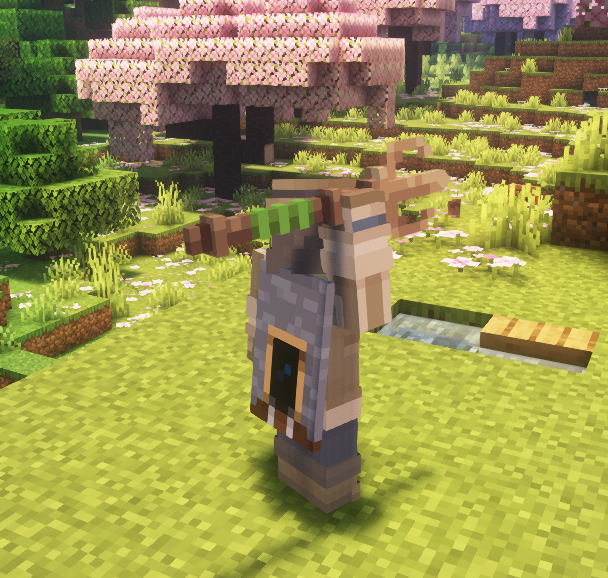
Showcasing Forest Trident
{% endembed %}
{% tabs fullWidth="true" %}
{% tab title="ItemModel (1.21.4+)" %}
For 1.21.4+ servers there are two approaches you can take, one being manually making the ItemModel, or let Nexo do it for you.
You will need 2 **Models** and 1 **NexoItem-Config** at minimum.
**Simple Method**
The simplest method is to let Nexo generate the **ItemModel** for you. For this you will need a NexoItem-Config like shown below. This specified a model & throwing\_model in Pack, which Nexo will use when making the ItemModel. The throwing\_model is usually the same as the model, but flipped in hand in programs like BlockBench
```yaml
forest_trident:
itemname: Forest Trident
material: TRIDENT
Pack:
model: nexo:item/nexo_tools/forest_trident
throwing_model: nexo:item/nexo_tools/forest_trident_throwing
Mechanics:
trident:
display_transform: HEAD
```
**Manual Method**
If you want to manually provide the **ItemModel** you will need a simplified config like below;
```yaml
forest_trident:
itemname: Forest Trident
material: TRIDENT
Components:
item_model: nexo:forest_trident
Mechanics:
trident:
display_transform: HEAD
```
\
The Forest Trident Nexo comes with uses a unified ItemModel to dictate when to show what model.\
This is mainly for displaying a different model when held/icon/throwing.\
Like the normal trident-item, which has a 2d Icon in GUIs, then also held in hand one way when throwing and normal.\
Below is the example Forest-Trident **ItemModel** Nexo comes with:
```json
{
"model": {
"type": "minecraft:condition",
"property": "minecraft:using_item",
"on_false": {
"type": "minecraft:model",
"model": "nexo:item/nexo_tools/forest_trident"
},
"on_true": {
"type": "minecraft:model",
"model": "nexo:item/nexo_tools/forest_trident_throwing"
}
}
}
```
This has a different **Model** based on the condition if the item is being used or not.\
This then goes into `assets/nexo/items/forest_trident.json` and is referenced in the NexoItem like below\
As shown above this **ItemModel** then links to two separate normal JSON-**Models**:\
`assets/nexo/models/item/nexo_tools/forest_trident.json`\
`assets/nexo/models/item/nexo_tools/forest_trident_throwing.json`